Listen to this piece. 16 minutes, read by James.
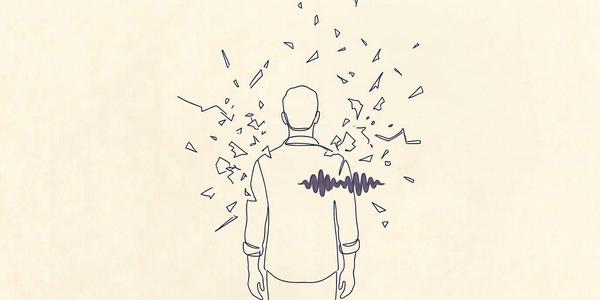
There's a man awake at 2AM.
He has an all-hands meeting in the morning. He'll stand in front of his team, and he'll be good, great actually. He'll be measured, clear, present. He's done it a hundred times.
But right now, in the dark, something else is true.
He was short with his kids at bedtime, not unkind, just not quite there. Back-to-back meetings until seven had seen to that. His partner tried to reach him later, in the quiet way partners do, and he didn't quite have it in him. He is in the house, but he's not home.
He knows this. He logged it somewhere deep inside and kept moving, because the morning was already close and the deck needed one more pass.
He is not struggling. By most measures, he is succeeding. But somewhere in the gap between who he is at 2AM and who he'll be on that stage at 9AM, something is being quietly spent.
Most leaders know this feeling. Most of them keep moving anyway.
The Doctrine of the Boxes
Here's what most of us were taught, not in a single lesson but in a thousand small signals from every system we moved through:
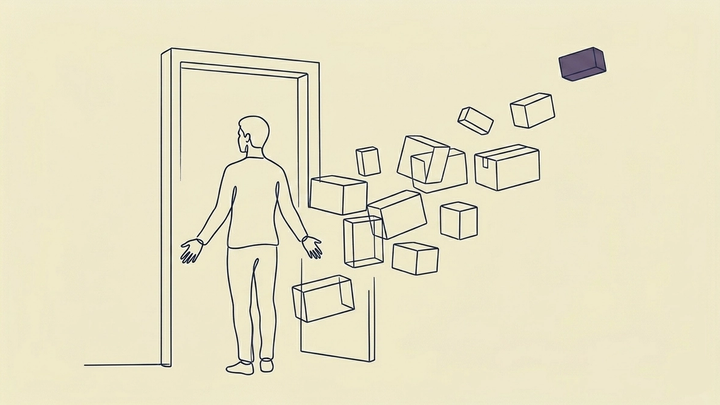
Separate it. Compartmentalize well. Perform in each domain. Keep the categories clean. Put everything in its proper box.
The leader at work, the partner at home, the parent on weekends. The friend, the son or daughter, the self, somewhere, theoretically, when there is time. A different version of yourself selected for each context. This was sold to us as sophistication. The professional who leaves their personal life at the door is admired; the one who brings their full humanity into the room is watched carefully.
We were handed a version of leadership built on division, and most of us accepted it, because the people handing it to us seemed to know what they were doing, and because it worked. For a while. In certain ways.
But here's what the boxes never accounted for: the man who is short with his kids at bedtime is the same man who was back-to-back until 7PM. The man awake at 2AM is the same man leading the all-hands at 9AM. The leader who can't quite connect with his partner is the same leader who will sit across from a struggling team member tomorrow and try to be genuinely present for them.
The boxes are not real. They never were.
Leadership has a human problem, and the problem is not that leaders are too human. The problem is that they have been asked, repeatedly and systematically, to divide their humanity from their work. To treat the most alive, most knowing part of themselves as a liability to be managed rather than a resource to be led from.
That division has a cost. And the 2AM man is paying it. So are his children. So is his partner. So is every person in that all-hands room who will receive a version of their leader that is present in body but somewhere else in mind.
We have been taught to manage the costs that show up in black and white, on income statements, in KPIs, in quarterly reports. We are fluent in those numbers. But there is another ledger. It doesn't get reviewed. And it compounds.
An Unfolding
I want to tell you something about how I came to understand this. Not as a theory — as a lived experience.
There wasn't a single moment of realization. It was slower than that, and more honest. An unfolding of recognitions, each one arriving quietly, each one asking something of me.
When I met my partner David, something shifted in how I understood connection. I had been, like many leaders, quite good at being with people in certain modes, professional, purposeful, visibly competent. What David offered was different: a relationship where I did not need to perform in order to be received. Where being fully known was not a risk but an invitation. Where I could be in the room as myself, without the architecture of a role to hide behind.
What surprised me wasn't how good that felt. Honestly, at first it felt foreign, unfamiliar in the way that honesty sometimes does when you've been performing for a long time. What I actually realized was how much energy I'd been spending constructing, maintaining, and performing a version of myself I thought would be safe and palatable for others. And what I noticed is that a long-held pattern doesn't dissolve the moment you see it. You just start making a different choice, again and again.
Then came the move out of the city, not a crisis, not a grand declaration, just a choice to create some room. More space, more nature, more quiet. More permission to be at a pace that was actually mine. I began spending more time in places and with people where I didn't need to be anything other than who I was.
A few years later, I closed BARKON, a functional hydration business I had been building. The decision took longer than it should have, and the delay told me something important. I had tied my worth to the performance of that venture in ways I hadn't been honest with myself about. The costs of closing it were real: money, time, something that looked like ego, and a friendship that did not survive the difficulty. I grieved all of that, painfully and slowly. It wasn't easy or quick.
But underneath the grief was something I hadn't expected: relief. Not because the hard thing was over, but because I had finally listened to what I had known for longer than I wanted to admit. I had chosen my own knowing over my own performance.
What I noticed, across all of it, was the same lesson.
Not a single lesson arrived at once. A recurring permission. Each time, a quiet decision to stop performing and start listening. To stop asking what is expected of me here and start asking what do I actually know, and perhaps most honestly, what is it that I actually want, for me?
I'll be honest: I fought this. More than once, I chose the crowd over my own knowing. I wanted to fit in, to perform the expected version of success, to be like everyone around me who seemed to have it figured out. Part of me wanted the boxes to be real, because at least the boxes were familiar. The alternative, turning inward, trusting what surfaced, felt like a risk.
That tension is part of this. I don't want to skip over it. The path back to yourself is not always clear, and the flinching is real. But I've come to believe that the flinching is not a sign that something is wrong. It's often a sign that you are getting close to something true.
The Word Underneath
I've come to believe that the most counter-cultural act available to a leader right now is not a new strategy. It is a simple, difficult, frequently avoided act of permission.
Permission to hear yourself.
Jim Collins has spent more than three decades studying what makes companies great. Good to Great, Built to Last, How the Mighty Fall, a body of work built on rigorous research, on data, on the disciplined study of organizational performance. And then something shifted. He spent the last ten years asking a different question: not what makes companies great, but what makes a life worth living.
The resulting book, What to Make of a Life, carries a subtitle that would have been unthinkable from the Collins of twenty years ago: The Self-Knowledge Imperative. It's not a soft book. It's as rigorous as anything he's written. But it turns the lens inward, and what it finds there is not a performance system. It's an encoding.
Collins argues that every person carries a constellation of intrinsic capacities, what he calls encodings, that are built into who they are, waiting to be discovered. The question is not whether you have them. The question is whether your current circumstances are drawing them out. When asked how to split the work between finding your encodings and trusting them once found, he put seventy points on trust. Not on the finding. On the trusting. The hardest part, he's saying, isn't knowing who you are. It's letting yourself be seen as that person.
He put seventy points on trust. Not on the finding. On the trusting. The hardest part, he’s saying, isn’t knowing who you are. It’s letting yourself be seen as that person.
This is the crossover that interests me most. The man who built a career on the study of Good to Great spent a decade arriving at the Self-Knowledge Imperative. That is not a departure from rigour. It is rigour applied to a harder question. And it is the same question this practice has been built around from the beginning.
The systems most leaders move through do not encourage this kind of inward work. They reward performance, adaptability, and the disciplined management of self. They are not designed for leaders who pause to ask: Did I choose this, or did someone hand it to me? Is this who I am, or who I agreed to be? Is this what I actually want, for me?
And yet the leaders who have done this work, who have given themselves this permission, who have listened even when the listening was uncomfortable, even when what surfaced made them want to look away, lead differently. Not with a better framework. With a clarity that no external system could have given them, because it comes from somewhere that has finally been allowed to speak.
This is not softness. It is actual leadership.
The Human Part Is the Advantage
I'm not saying that going inward is easy, or that it resolves complexity, or that it produces a life without challenge. The leaders I respect most, the ones who have done this work with genuine seriousness, haven't arrived somewhere easier. They've arrived somewhere true. And from that place, they lead and live with a quality of presence and clarity that no external framework could have given them.
What I'm saying is that the division, the doctrine of the boxes, the performance of a self that has been sorted into categories, is not the unavoidable cost of leadership. It's a choice. One that was made for us, long before we arrived, by systems built for a different era and a different set of answers.
Those same systems taught us that real knowledge comes from the outside. A degree, a certification, a methodology with a name and a logo. The implicit message: your own knowing is insufficient. Import the answer from somewhere credible. Trust the framework more than yourself. We were rewarded for this. And in being rewarded, we learned to look outward as a reflex, even for questions that could only ever be answered from within.
Leadership has a human problem. The problem is the division. And the resolution is not better compartmentalization. It's integration.
Not balance. Integration.
Balance implies the boxes are real and simply need to be managed more skillfully. Integration says the boxes were never real, and the energy spent maintaining them is available for something else. For leading from the fullness of who you are, rather than from the (TM) version of yourself you've spent years making presentable.
The human part is not the liability. It never was. It is the most precise, most generative, most strategically significant resource a leader has. The leaders who understand this don't just lead differently. They build differently, sustain differently, they leave a different kind of mark.
The Question
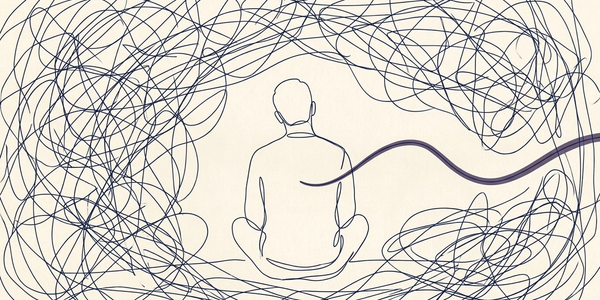
Much of what leaders are experiencing right now, the noise, the instability, the sense of carrying something that doesn't quite fit, is not a leadership failure. It's what happens when a person of real depth and genuine capacity tries to contain themselves into boxes, into roles, rules, and structures that someone else handed them for someone else's purposes.
The instinct in those moments is to look outward. A better methodology. A different structure. Another course, another framework, another external map.
But the map you’re looking for was drawn on the inside.
The leaders who have made this turn, who have gone inward not in retreat and not as an escape, but as the most serious act of leadership rigour available to them, don't find a simpler version of their work. They find a clearer one. They remember who they are. They lead from that remembering. And the people around them feel the difference, even if they can't name it.
This is the conversation I built humanKIND around, for myself as much as for anyone. Because I need this permission too. I need a practice and a place where the interior life of a leader is not a footnote to the real work but the beginning of it. Where coming home to yourself is not a retreat from ambition but the source of it.
There are things we've observed about what becomes possible when leaders make this turn. Patterns in how they perform, how they relate, how they build. A different set of truths about what leadership is and what it genuinely asks. That is what comes next.
But it begins with one question.
What happens when you stop performing leadership and start leading from your own knowing?
Find a few minutes of genuine quiet. Not the quiet between meetings — the other kind.
Then ask yourself, as honestly as you can: What do I already know that I haven’t given myself permission to act on — to be, to embody, to feel?
Don't reach for the answer. Let it surface. Write down whatever comes — one sentence is enough.
That sentence knows something. Follow it.
The Being comes first. The Knowing follows. The Doing takes care of itself.
James Powell is the founder of humanKIND, a human-centred leadership coaching and advisory practice. This piece is the first in a series on what it looks like to lead from your own knowing, and what becomes possible when we do.
The Weekly Alignment
One short piece each week. Not advice, and nothing to keep up with. A reminder, arriving on a Thursday, that the ground was always there.
Unsubscribe any time. Nothing else is sent.